Exploration of new online methods for monitoring and analyzing bathing water quality
This is Isabel Erb’s doctoral research project. Isabel is an industrial PhD student at Sweden Water Research and Lund University.
PHD PROJECT Isabel Erb is involved in several projects related to water quality. In the Urban Bathing project, she investigates why and under what conditions poor bathing water quality occurs, as well as whether it is possible to accelerate the currently time-consuming process of manual sampling and analysis of bathing water quality.
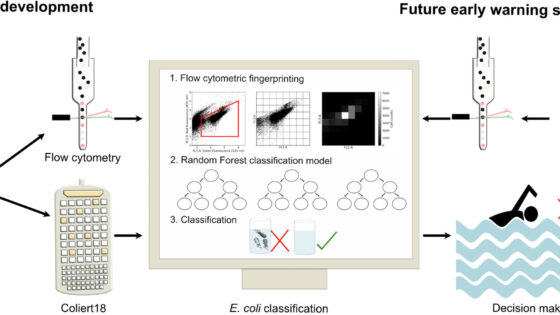
She has analysed indicator bacteria and their origins in bathing water. She has also used new online methods to monitor microbial water quality and demonstrated that it is possible to determine microbial water quality in bathing water in less than an hour using flow cytometry and machine learning.
After presenting proof of concept for this new method, the focus is now on applying the developed approach to larger datasets generated using automated instruments during the summers of 2022, 2023 and 2024. This will both validate the method on a larger dataset and deepen understanding of how certain abiotic factors can influence bathing water quality.
In the long term, the knowledge gained about bathing water quality can also be applied to other types of water and used in a broader context. The potential for this was explored in spring 2025 when Isabel undertook a research exchange in Iceland. Together with Veitur (Reykjavik’s electricity, heating, water and sewage company), she worked on a project applying machine learning algorithms to online flow cytometry data to gather information on anomaly detection, seasonal variations, biostability and the impact of weather parameters on microbial drinking water quality. The results of this project are expected to facilitate the analysis of data from online flow cytometry to enable more informed decisions regarding microbial water quality.
This PhD project is a part of the Urbana Bad project.
Supervisor: Catherine Paul, Lund University
Co-supervisor: Niklas Gador, Kristianstad University, Ellen Edefell, Sweden Water Research