New Module for Water Quality Calculations in Opti-SITE
During 2025, a new methodology for automated stormwater quality calculations has been developed within the Opti-SITE project.
The new methodology includes, among other things:
- Calculation of pollutant loads for 15 different stormwater contaminants, based on land use and standardised values
- A library of nature-based stormwater solutions (NBS) and their treatment performance for different pollutants
- Identification of areas suitable for the implementation of NBS
- Identification of which impervious surfaces can be connected to a nearby NBS
- Calculation of the combined treatment effect when many NBS are placed in different locations across a city
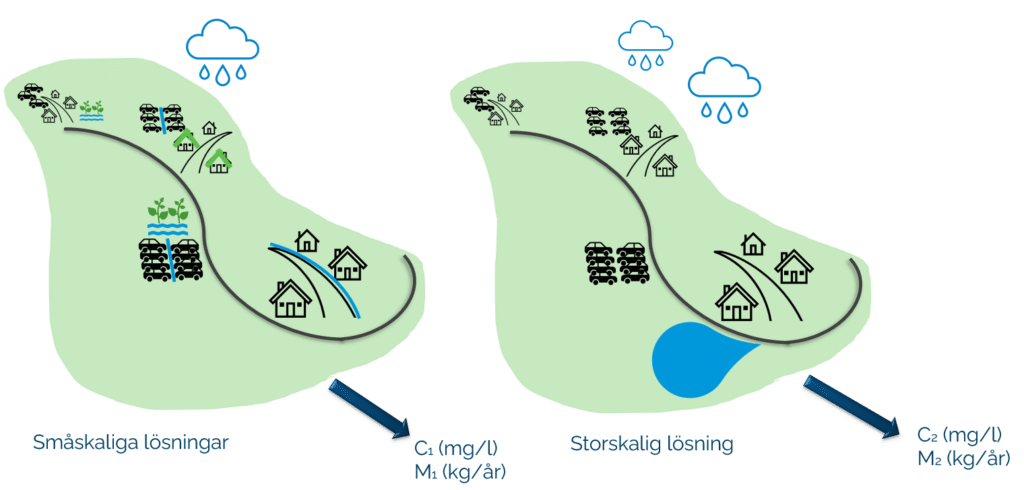
- Adaptation of the methodology to handle both small, local NBS and larger, centralised solutions that treat water from wider catchments
These steps can be run in several loops to gradually evaluate progress towards a set target and iteratively adjust the proposals. The next major step is to link the stormwater quality module with Opti-SITE’s optimisation module, enabling many different alternatives to be tested and compared in order to find optimal solutions for stormwater management from a water quality perspective.
Progress and Further Questions
Experts from DHI specialising in GIS, stormwater quality, and nature-based solutions have been working on the development during autumn 2025 and winter 2026. The work has raised several unexpected and intriguing detailed questions that need to be resolved to allow the process to be automated rather than handled manually. Examples include:
- How far from an NBS can an area be located while still remaining practically feasible to connect?
- What level difference is acceptable between the area being connected and the NBS?
- How do we design a database capable of storing and processing large amounts of data without becoming unreasonably large or difficult to work with?
The purpose of Opti-SITE’s optimisation module is to create overarching solutions for entire cities, based on many small-scale measures. This means that not every detail needs to be exact everywhere, but at the same time, the proposed solutions must be realistic and practically feasible.
We are now looking forward to the next phase: linking the stormwater quality module with the optimisation module and exploring what this means in practice. We expect new questions and challenges to arise along the way – and we are ready to tackle them together with LTH.