
Can treatment wetlands meet future EU requirements for wastewater treatment?
Industrial PhD candidate Ashley Hall’s latest article in Water Science and Technology examines this issue.
Treatment wetlands are widely used for greywater treatment in Europe, but upcoming stricter nutrient limits in the revised EU Urban Wastewater Treatment Directive (EU 2024/3019) raise questions about their ability to meet future standards. This is especially relevant as interest increases in scaling systems beyond 1,000 PE and in reusing treated greywater, which under the EU Water Reuse Regulation (EU 2020/741) requires compliance with EU 2024/3019 effluent limits.
To assess performance under these conditions, four greywater treatment wetlands and one mixed wastewater reference wetland were monitored for 18 months. All wetlands consistently produced dissolved COD below 50 mg/L, within the strictest limit of 125 mg COD/L. However, only three of the wetlands achieved total nitrogen concentrations below the required 6 mg N/L. Regarding total phosphorus, only the two wetlands, which used phosphorus adsorbing media, met the 0.5 mg P/L limit.
Performance was not strongly linked to flow path design. Instead, lower nitrogen loading and use of phosphorus adsorbing media were associated with higher quality effluents. Other factors, including system age and groundwater interactions, showed no consistent influence across sites. Overall, results show that treatment wetlands can meet EU wastewater requirements for greywater, though nutrient removal may require targeted design strategies.
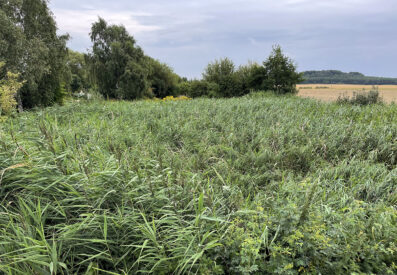
Wetland in Toarp outside Malmö
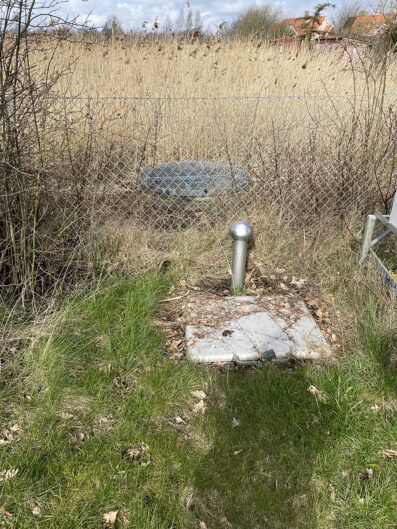
Wetland in Toarp outside Malmö
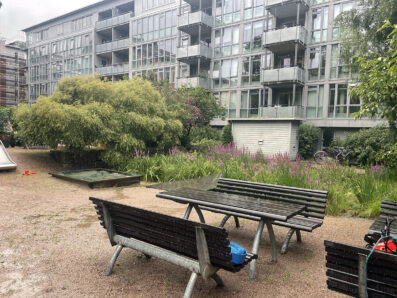
Klosterenga
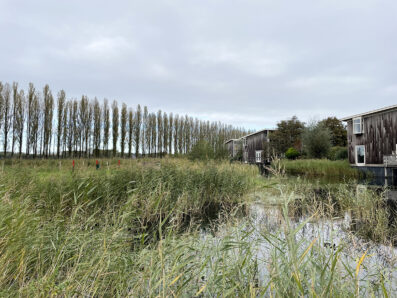
Wetland in Drielanden