
A future to long for: DISCO partners explore water solutions in Malmö and Lund
How do you save drinking water, manage heavy rain and clean polluted stormwater in cities that keep growing? On 1 October 2026, 35 participants from seven countries went to see the answers in practice. The day after the DISCO partner meeting, Sweden Water Research and the City of Malmö hosted a transnational field trip to four places where water innovation is tested in real life: a residential community, a university campus, a wetland and a research hub.
Sege Park: living closer, using less
Our first stop was Sege Park in Malmö. The low yellow buildings of this former psychiatric hospital now stand in a mature park with tall trees and open green spaces. In the communal housing Röda Oasen (“Red Oasis”), around 40 people –30 adults, 11 children and three cats– share their daily life, from house meetings to cooking teams and technical tasks.
– Most of the people who live here also have this climate aspect, says resident Stina Nylinder. This is a way to be able to cope with climate change: you are more secure, you have more food safety, and we live closer and slower.
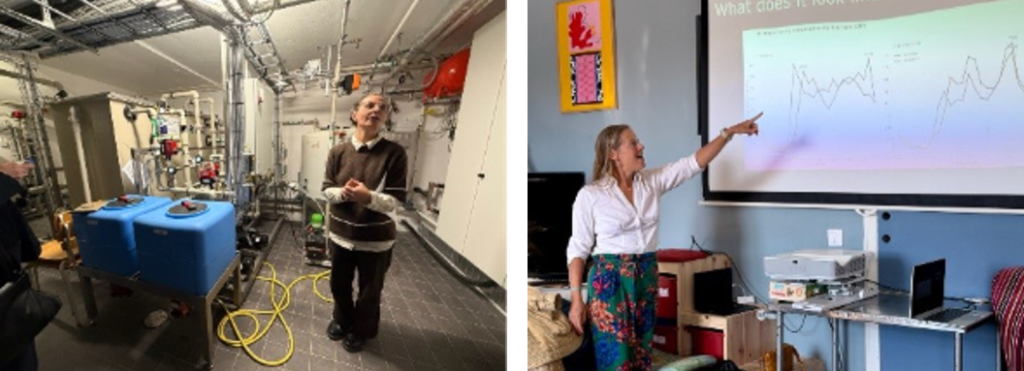
Stormwater (REWAISE installation) is purified and reused on site in the basement of Röda Oasen.
At the welcome, Victoria Rydengård, DISCO project manager at Sweden Water Research, shared results of DigiDrop, the DISCO tool that measures individual water usage in apartments. In the Sege Park area people use 111 litres per person per day, about a fifth less than the 140 litres often quoted as the average per person in Sweden. Showering, toilet flushing and the kitchen tap together account for four-fifths of their use.
Down in the basement, Röda Oasen tests another way to save drinking water. Within the EU project REWAISE, stormwater and drainage water are purified with ceramic membranes and reused for toilets and washing machines, a first for a residential building. The clean water is in constant use: standing next to the installation, you can frequently hear someone flush upstairs. Residents share responsibility for the facility, which could save around 450,000 litres of drinking water a year.
Elin Hasselberg of the City of Malmö’s Environment Department brings residents, city departments, building owners and projects like DISCO together in Sege Park four times a year. That is exactly the gap DISCO wants to bridge: between public authorities and the residents they serve. “My drive for projects like DISCO is really: how do we fit people into the topic of sustainable development, and how do we create cities and a future that we can long for instead of fearing?”
Lund University: when the forecast opens the valve
On the campus of Lund University, Hanna Nordlander and John Hägg, investigation engineers at the regional water utility VA SYD, showed how the stormwater pond Pölen and the lake Sjön have become a smart buffer against heavy rain. A level sensor sends data via a small on-site computer to a cloud platform, which combines it with rain forecasts and measured rainfall. When a heavy downpour is on its way, a valve opens and the upper pond is lowered a few hours in advance, creating extra storage space.
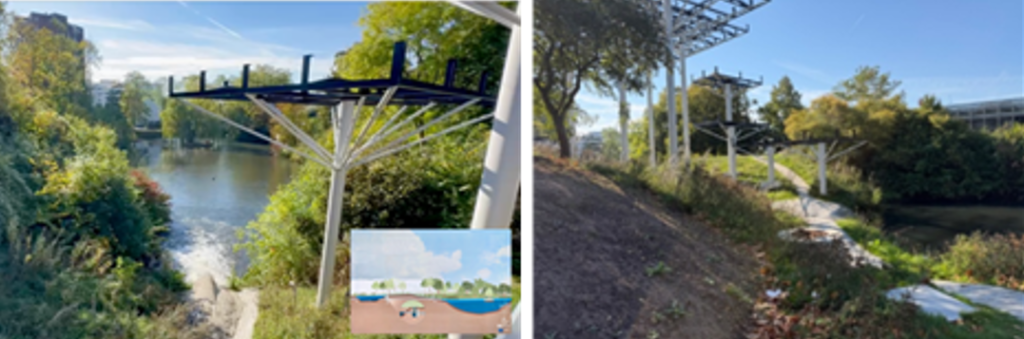
Weather forecasts decide when the pond on the Lund University campus makes room for rain.
The system, developed together with property owner Akademiska Hus, has been running since March 2025 and has already handled a rain event that statistically occurs only once every 15 years. There are bonuses too: flowing water makes the campus more attractive, and during this summer’s drought the municipality used water from the ponds for nearby trees.
For OOWV, this stop hit close to home. In Damme, Lower Saxony, the German water utility is developing a digital twin for a rainwater retention basin as its DISCO pilot. Their questions went straight to the core: how much buffer do you need, and when do you start emptying the basin? How do you implement weather forecast?
Värpinge Wetland: nature doing the cleaning
Rainwater running off houses, streets, industrial areas and farmland in western Lund carries nutrients, metals, microplastics and even PFAS. Before it reaches the river Höje å, the constructed Värpinge Wetland filters out much of this pollution. But crowded cities rarely have room for a wetland. That is why the research project ISWIM tests compact alternatives right next to it, under real conditions -cold, heat and rain- before they are scaled up.
Researchers Franz Geronimo and Xuekai Jiang explained the two-step set-up. First, the water is treated with membrane filters or with biofilters of sand, gravel and plants; half of the biofilters are enriched with biochar, so the researchers can measure the difference. Then the water runs through twelve columns with different types of biochar and activated carbon, to see whether they also capture dissolved metals and PFAS. ISWIM is led by Sweden Water Research together with Lund University, Luleå University of Technology, Malmö University, VA SYD and other partners, and is funded by the Swedish research council Formas.

Värpinge wetland in Lund.
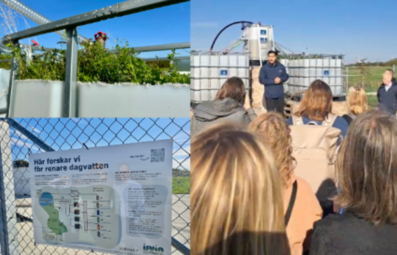
At the ISWIM test site, compact treatment methods are compared side by side, explains researcher Franz Geronimo.
Examples from other research projects
The day ended at Sweden Water Research, situated in a beautifully restored industrial building in Lund. After a welcome by CEO Henrik Aspegren, moderator Nina Steiner introduced five speakers:
Jesper Knutsson (Chalmers University of Technology) shared ten years of lessons from HSB Living Lab, a residential testbed with some 2,000 sensors: technology is rarely the hardest part: behaviour, regulation and the market decide what scales.
Emanuel Toft (City of Malmö) presented HeatSafe, which maps who is most vulnerable to heatwaves and the correlation between indoor and outdoor temperatures with water usage.
Maria Roldin (DHI) presented Opti-SITE, which combines AI, radar data and nature-based solutions to optimise stormwater systems.
Maria Sätherström-Lantz (WIN Water) showed how her network #Water Valley connects water challenges with 175 innovation companies from 15 countries.
Pia Jacobsen, Head of Global Innovation talked about how Water Valley Denmark unites the Danish water industry to drive innovation
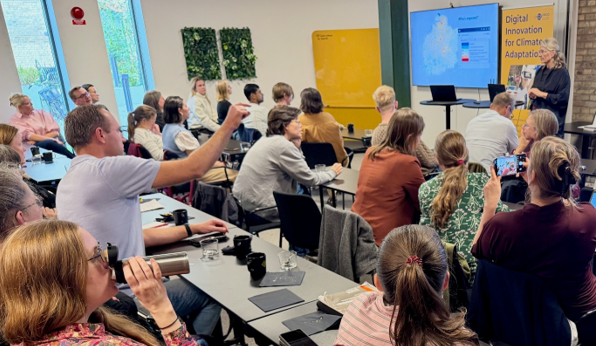
A full house at Sweden Water Research in Lund, for the afternoon programme with five interesting speakers.
What partners take home
For OOWV, every stop connected directly to its own work. Julia Oberdörffer and Katharina Buss summed up three takeaways. In Sege Park, rainwater -built into an existing building- isn’t simply drained away but used with residents closely involved. On Lund University campus, forecast-based control links to OOWV’s own DISCO pilot. And at Värpinge, different purification methods are compared side by side. “These are great insights” says Julia Oberdörffer. “You don’t have to start from scratch and you can draw on these ideas in your work.”
That is exactly what a transnational field trip is for. As Katharina Buss puts it:
– It’s really inspiring to hear how other people face the challenges we are all facing. The exchange with one another, also in person, is really beneficial.